

Our Research & Projects
Building the human brain architecture: Patterning, Mechanics & Self-Organization
Our lab investigates how the human brain builds its own architecture: how regional identity, cell fate, and three-dimensional tissue organization emerge through the interplay of molecular programs, mechanical forces, and self-organizing dynamics. We aim to uncover the developmental logic that connects gene expression, tissue mechanics, and morphogenesis, and to understand how these dynamic processes are altered in disease.
Our research is organized around three interconnected themes:
1. Understanding Brain Development
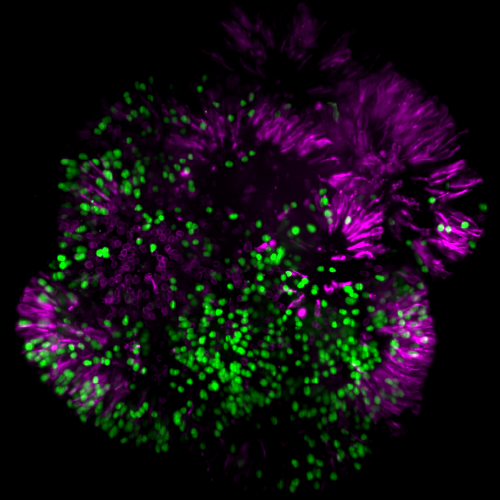
We use human stem cell–derived brain organoids to study how spatial patterning, regional identity, and morphogenetic movements coordinate to form complex brain structures. We are particularly interested in how cell-fate determination couples with 3D morphogenesis, and how physical and molecular cues together shape neurodevelopmental trajectories.
Using long-term lightsheet microscopy, we follow organoid development continuously for weeks to capture the real-time emergence of tissue architecture and differentiation. These datasets enable quantitative analysis of cell and tissue dynamics, revealing how patterning signals, cell behaviors, and mechanical constraints integrate over time.
2. Modeling Disease & Disorders
We model neurodevelopmental and neurodegenerative disorders by introducing disease-relevant genetic or environmental perturbations into human organoid systems. This allows us to pinpoint how developmental programs and tissue organization fail, and to identify the genetic, cellular and morphogenetic signatures underlying disease states. We will employ a morphodynamics approach to elucidate the cellular migration and maturation dynamics that are dysregulated in neurodevelopmental disorders.
3. Building Integrative Tools
A central mission of the lab is to develop technologies that bridge live imaging and gene expression data across scales. We are creating multimodal experimental and computational pipelines that combine long-term lightsheet imaging with single-cell and spatial transcriptomics, supported by AI-based image analysis and data integration. Building on our expertise in multi-week, multi-mosaic lightsheet imaging and demultiplexing, we aim to construct a dynamic, in-toto view of organoid development that quantitatively maps morphology to molecular state. Our goal is to establish comprehensive spatiotemporal tissue phenotyping and create a mechanistic link between imaging-based dynamics and gene expression to better understand both normal development and disease.